for complex industrial airflows, zoned
environments, and demanding operational
schedules.
Understanding Industrial Air Handling Units
Central Air Management for Multi-Zone Industrial Operations.
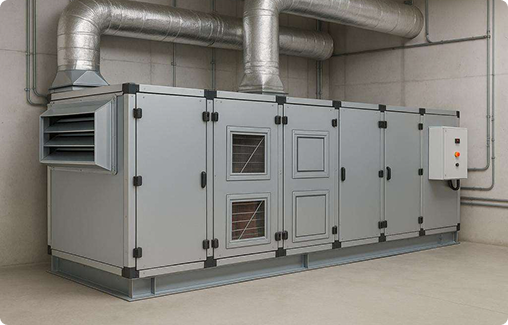
Industrial Air Handling Units (AHUs) are the central nervous system of large-scale HVAC infrastructure. They consolidate the functions of air filtration, heating, cooling, humidification, dehumidification, and distribution into a single integrated system — delivering conditioned air across multiple zones from one central plant.
Unlike standard commercial AHUs, industrial-grade units are constructed for continuous high-load operation in harsh environments. Key characteristics that set them apart:
- Heavy-gauge casing with double-skin insulated panels for structural integrity and thermal efficiency
- High-capacity fan arrays handling airflows from 5,000 to 500,000+ m³/hr
- Multi-stage filtration from G4 pre-filters to F9 fine filters and HEPA configurations
- Full BMS integration with variable air volume (VAV) control and demand-based ventilation.
They serve as the primary air conditioning backbone for manufacturing plants, hospitals, pharmaceutical facilities, and any complex building requiring centrally managed, distributed air delivery across diverse internal zones.
Typical Industrial Applications
Engineered for Multi-Zone Complexity, High Airflow, and Uninterrupted Operation.
Industrial AHUs are deployed wherever a facility requires centralised, controllable air delivery across multiple spaces with different thermal and air quality requirements.
Manufacturing & Production Facilities
Delivers zone-specific conditioned air to production areas, assembly lines, quality control zones, and staff welfare areas each with independently controlled temperature, humidity, and fresh-air ratios.
Large Commercial & Mixed-Use Developments
Serves high-rise office towers, shopping complexes, hotels, and multi-tenant developments where a single central AHU plant conditions air for distribution across dozens of independently occupied zones.
Healthcare & Hospital Infrastructure
Maintains infection control standards through pressure differential management between surgical theatres, isolation rooms, general wards, and support areas.
Pharmaceutical Manufacturing Plants
Supports GMP-compliant production environments where temperature, humidity, and particulate levels are tightly regulated across multiple classified zones.
Industrial Air Handling Units Configurations
Industrial AHUs are specified in consultation with your engineering team — sized to actual airflow demands, filtration requirements, and available plant room or rooftop space.
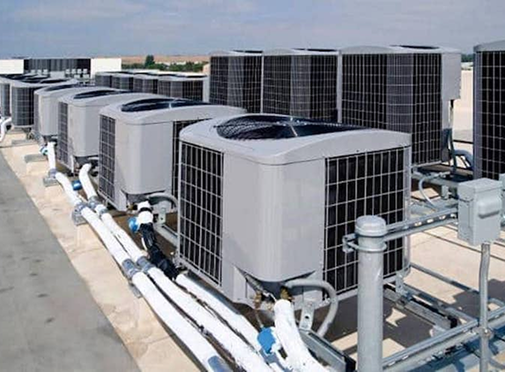
Rooftop & Plant Room AHUs
Manufacturing plants, office towers, hospitals, large commercial complexes.
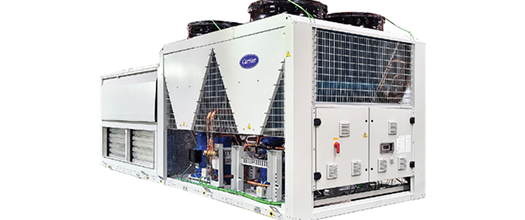
Direct evaporative coolers draw warm outside air through water-saturated cellulose or rigid media pads, lowering air temperature through evaporation before discharging into the facility. Best suited for hot, dry climates where evaporative cooling is most thermodynamically effective. Units can be roof-mounted, wall-mounted, or duct-distributed depending on coverage requirements.
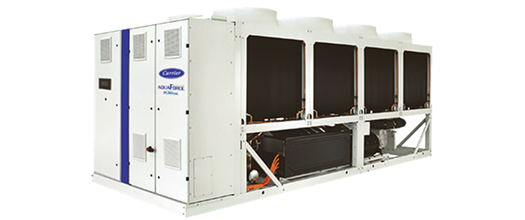
Modular & Custom-Built AHU Assemblies
Pharmaceutical facilities, cleanrooms, specialist industrial applications.
Where standard catalogue units cannot meet specific process or regulatory requirements, we configure modular AHU assemblies from purpose-built sections — combining bespoke coil arrangements, specialist filter housings, stainless steel or epoxy-coated casing, and custom fan plenum designs. Each assembly is factory-tested to confirm performance at rated airflow before delivery, minimising commissioning time on-site and providing documented performance certification prior to handover.
Why Choose Carrier Industrial Air Handling Units
Built for Continuous Operation, Multi-Zone Flexibility, and Long-Term Reliability.
We work with leading AHU manufacturers whose products are tested and validated for industrial performance. Our engineering team begins every AHU project with a comprehensive review of your facility’s thermal and air quality demands — ensuring that every unit is correctly sized, properly specified for filtration grade, and integrated with your existing building controls infrastructure.
High-Capacity Airflow Performance
Units specified across a wide range of duty sizes — from compact 5,000 m³/hr configurations to large-scale assemblies exceeding 300,000 m³/hr for industrial plant applications.
Full BMS & Controls Integration
Bacnet, Modbus, and LON-compatible controllers provide seamless integration with your existing building management infrastructure, enabling demand-controlled ventilation and centralised monitoring.
Advanced Filtration Options
Configurable filter stages from standard G4 particulate pre-filters through to F9 fine filters, activated carbon panels, and terminal HEPA filtration for classified environments.
Heat Recovery as Standard
Rotary heat wheels, plate heat exchangers, and run-around coil systems recover thermal energy from exhaust air — reducing heating and cooling loads by up to 75% on fresh-air supply.
Engineering, Installation & Commissioning
Correct Ductwork Design and Commissioning Are as Critical as the Unit Itself.
Industrial AHU installations require careful coordination between ductwork design, structural support, services penetrations, and controls integration. Our mechanical engineering team manages every stage of the process — from ductwork static pressure calculations and diffuser placement through to full commissioning, air balancing, and BMS point-mapping.
Every system we commission is air-balanced and functionally tested across all zones before handover. We provide a full commissioning report documenting actual versus design airflow at each terminal, fan performance data, filter pressure drops, and controls verification — giving your facilities management team a complete operational baseline from day one.
Energy Performance for Industrial HVAC Infrastructure
High-Performance Air Handling with Measurable Energy Savings.
Modern industrial AHUs incorporate electronically commutated (EC) plug fan arrays that adjust speed in direct response to system pressure demand — eliminating the energy waste inherent in fixed-speed fan operation. Combined with heat recovery and demand-controlled ventilation, these features can reduce a facility’s HVAC energy consumption by 40–60% compared to older constant-volume systems operating without energy recovery.
For facilities operating 24 hours per day across multi-shift schedules, this directly translates to substantial annual reductions in energy expenditure — improvements that compound over the 20-25 year operational lifespan of a well-maintained industrial AHU installation.
Need an Industrial Air Handling Solution for a Large or Complex Facility?
Tell us about your building, airflow requirements, filtration standards, and operational schedule. Our engineering team will design a system that delivers the performance, reliability, and compliance your facility demands.